
Life OS: a private health, money and calendar dashboard
July 30, 2026
Life OS is my own private dashboard: health, money and calendar in one read-only page I host myself. Each domain keeps its own SQLite database and its own writer. The dashboard owns no data, it opens each database read-only and recomputes everything on request, so there is never a stale copy to reconcile. It is reachable only over my private network, never the public internet. The screenshots on this page run on mock data.
You are reading the plain-language version. Switch to Tech for the code and the architecture.
Question
What is my net worth right now, and what is missing from that number?
Answer
Recomputed on the spot: the mortgage is amortized forward from its anchor date rather than read from an old statement, and crypto is quantity times live price, never a stored valuation. The page also reports 13 of 14 accounts valued and names the one still missing, so an incomplete total is visible instead of silently wrong.
Sources
wealth.sqlite · accounts + loanshealth.sqlite · sleep + stepsI build private dashboards that pull your scattered data into one read-only page you own. Your systems keep their data, the dashboard reads them and aggregates the answer you actually need, hosted on your own network with nothing published to the internet.
Why this matters to you
The answer you need already exists inside your business. It’s split across four tools, and none of them holds the whole question. So somebody opens five tabs, copies numbers into a spreadsheet, and produces a picture that’s stale the moment it’s finished. That person is usually your most expensive one, and the ritual repeats every week while the version that reaches a decision is a screenshot in a chat thread.
The quiet failure that costs money
The failure that costs real money is the number that looks complete when it’s short a source. One feed hadn’t reported yet, so it counted as zero, and the total came out confidently wrong. Nobody questions a clean-looking dashboard. I shipped this exact bug on my own money: the net figure was wrong by the price of an apartment for two weeks while looking perfectly healthy. In a business that number is a board deck or a cash decision made on a total that was never real.
What actually helps
The dashboard leaves every source in charge and only adds a reader on top, so there’s no second copy of your numbers to secure and reconcile. Numbers that decay get recalculated on every view, so they stay current instead of freezing at the date somebody last exported them. Every panel says when it doesn’t know, and missing sources are named on screen, so an incomplete total shows up as incomplete.
- One page that answers the question, instead of four tools each answering a fragment.
- The weekly reporting ritual drops from hours to a glance. No copy-paste, no stale screenshots in a chat thread.
- Read-only by construction. The driver itself rejects writes, so you can point it at production without a migration or a change freeze.
- Nothing published. It runs on your private network and won’t start on a public interface, so there’s no login page to leak.
This is the architecture behind my own daily dashboard, aggregating health, finances and schedule from three separate databases into one page.
What I can do
I build the reader over your existing systems, and I can start by mapping where your answer is scattered and what one page would need to pull it together. The honest boundary: this is a read layer, so it doesn’t fix data quality. If a source is wrong or hasn’t reported, the dashboard names it clearly. It won’t invent the missing number.
Want me to look at yours, in writing?
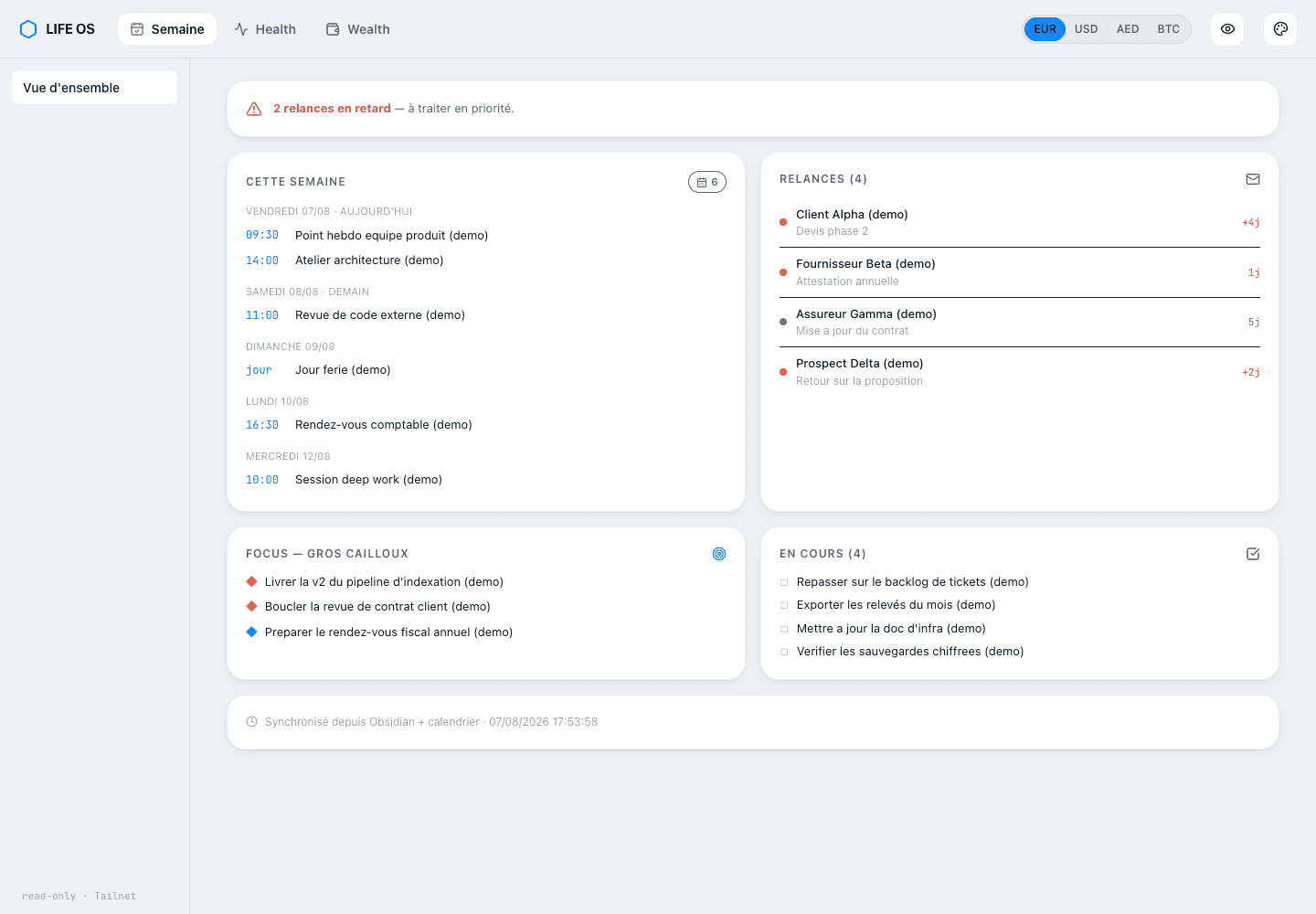
Life OS is a single read-only page that pulls health, wealth and my week into one view, served only inside my private network, with zero write paths and zero ports open to the internet.
One question, “am I sleeping enough and can I afford to slow down”, used to mean opening five things: a fitness app, two banking apps, a spreadsheet, and my notes. Each held a true fragment while none held the question, so every check-in cost fifteen minutes and I stopped bothering.
All screenshots below run on mock data. I wired the app to a fake API for this article. Every account name, balance, heart rate and calendar entry you see is invented. The interface is in French because I am the only user.
The data already existed, the aggregation did not
I already had the pieces. A health service syncs Fitbit into health.sqlite, a wealth service ingests bank statements into wealth.sqlite, and my notes live in an Obsidian vault. Three services, each with its own owner and its own schema.
The tempting move is to build a fourth database that copies all of it. That’s how you end up with a sync job to babysit and two numbers that disagree.
So I inverted it: the dashboard owns no data at all. It’s a reader. Every domain database stays owned by the service that writes it, and the dashboard opens each one in read-only mode:
def ro(db_path: str) -> sqlite3.Connection:
    """Connexion STRICTEMENT read-only. Toute ecriture leve OperationalError."""
    con = sqlite3.connect(f"file:{db_path}?mode=ro", uri=True)
    con.row_factory = sqlite3.Row
    return con
That ?mode=ro URI flag is the entire access control model for data. SQLite enforces it at the driver level, so a bug in my HTTP handler can’t turn into a mutation.
The opinion: for personal infrastructure, a read-only view over databases somebody else owns beats a warehouse you have to keep in sync. The dashboard can be wrong about presentation, but it can’t be wrong about the numbers, because it holds none of its own.
Three databases, one page, zero copies of the data.
The write path is separate and deliberate: I talk to a Telegram bot to log anything. Telegram writes, the web reads. No forms, no edit buttons, no CSRF surface, no accidental double entry from a phone in a pocket.
The network is the authentication
There’s no login screen and no session cookie. There’s no password to leak either, because the server won’t bind a public interface:
def tailscale_ip() -> str:
    """IP Tailscale de la box. Fail loud si absente: on ne bind PAS 0.0.0.0."""
    try:
        ip = subprocess.check_output(["tailscale", "ip", "-4"], text=True).strip().splitlines()[0]
    except Exception as e:
        sys.exit(f"REFUS: pas d'IP Tailscale ({e}). On ne bind pas une interface publique.")
    if not ip or ip.startswith("0."):
        sys.exit(f"REFUS: IP Tailscale invalide ({ip!r}).")
    return ip
If Tailscale is down, the dashboard doesn’t start. It won’t fall back to localhost, and it won’t helpfully bind everything either. A dashboard holding my medical and financial history should fail closed, and fail loudly.
The part I care about more is that a test proves this on every commit. My pre-commit script boots the real server on a scratch port and then runs a negative test: if 127.0.0.1 answers, the bind is too wide and the check fails.
# le bind doit etre Tailnet-only : localhost NE doit PAS repondre
if curl -sf "http://127.0.0.1:$PORT/api/ping" >/dev/null 2>&1; then
  fail "repond sur 127.0.0.1 -> bind trop large (pas Tailnet-only)"
fi

# read-only prouve, pas commente
python3 -c "
import sqlite3
c=sqlite3.connect('file:/opt/health/health.sqlite?mode=ro',uri=True)
try:
    c.execute('CREATE TABLE _probe(x)'); raise SystemExit('ECRITURE POSSIBLE')
except sqlite3.OperationalError: pass
" || fail \"la DB n'est PAS read-only\"
The same script greps the source for INSERT, UPDATE, DELETE, DROP and ALTER and refuses the commit if any appear. Read-only is a property I verify on every change.
Numbers that decay must be computed at read time
Bank statements are snapshots. A mortgage balance keeps changing.
My first version stored the loan balance like any other account, from the last PDF statement. It was correct on the day of ingestion and wrong every day after. Worse, it was wrong in the one direction nobody questions: the debt looked bigger than it was, my net worth looked lower than reality, and the figure never moved, so nothing on the screen told me it was stale.
The fix was to stop storing the answer and store the anchor instead. The database keeps a balance, a date, a rate and a monthly payment. The API amortizes forward to today on every request:
def amortized(loan):
    """Solde restant du AUJOURD'HUI, calcule par amortissement depuis l'ancrage."""
    anchor = date.fromisoformat(loan["anchor_date"])
    today = date.today()
    m = (today.year - anchor.year) * 12 + (today.month - anchor.month)
    if today.day < (loan["pay_day"] or 1):
        m -= 1
    m = max(0, m)
    r = (loan["rate_pct"] or 0) / 100 / 12
    bal, pay = loan["anchor_balance"], loan["monthly_payment"] or 0
    for _ in range(m):
        bal = max(0, bal - max(0, pay - bal * r))
    return round(bal, 2), m
Crypto gets the same treatment. Holdings store a quantity only, and the value is quantity multiplied by the latest price at read time. A stored valuation is a lie with a timestamp.
The loop is a few hundred iterations at worst and the whole request stays under a few milliseconds, so there’s no reason to cache it. The opinion: for a single-user dashboard, recompute everything on every request. A cache here would only buy you staleness bugs.
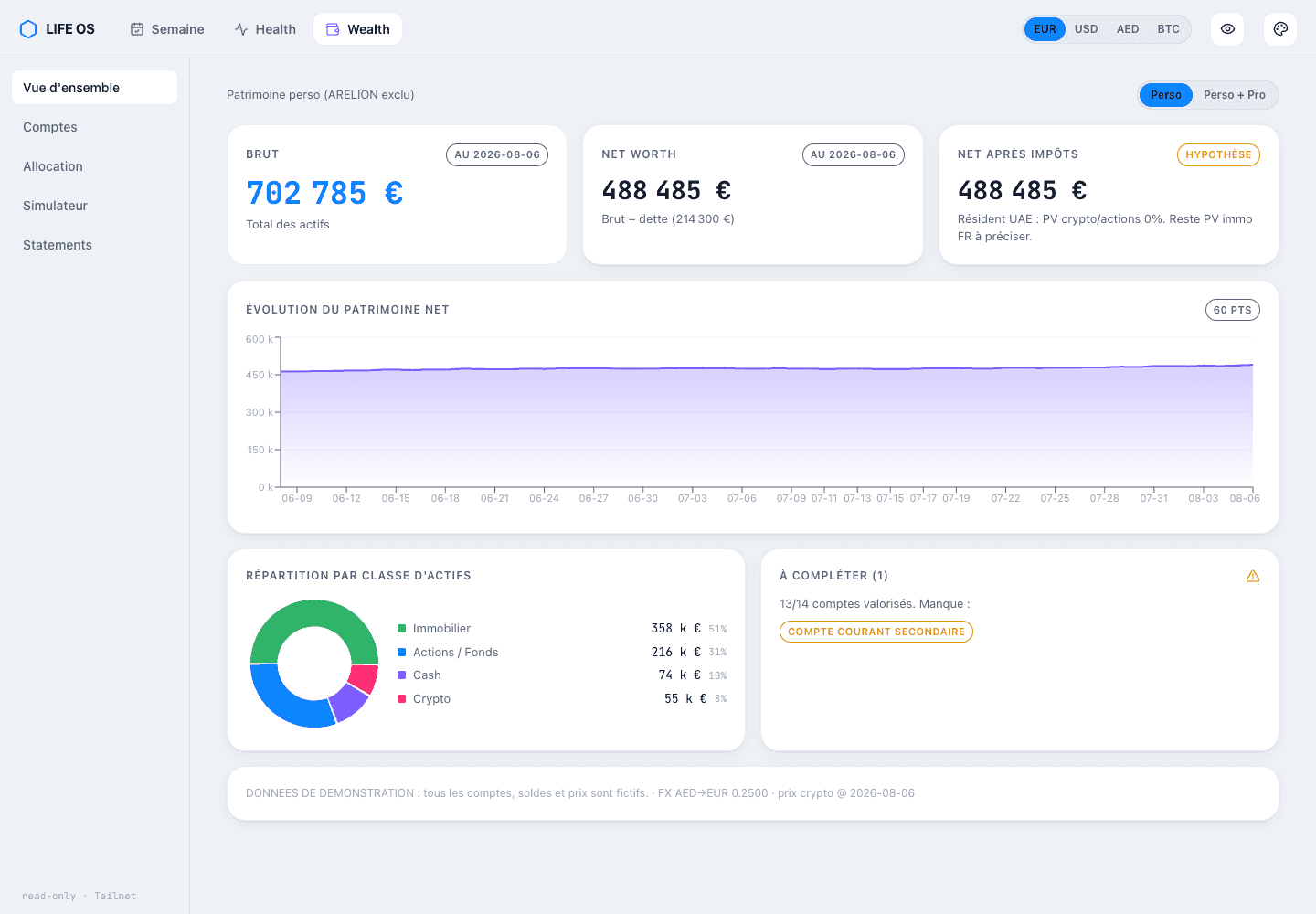
War story. For two weeks my net worth was wrong by the price of an apartment while the screen looked perfectly healthy: the mortgage had a statement and counted as debt, the flat had no valuation row and counted as zero, so net worth silently became “assets minus a mortgage on an asset that does not exist”. No error, no empty state, just a confident number hundreds of thousands too low. The fix is four lines:
property_missing = any(r["kind"] == "property" and eur(r) is None for r in rows)
net_incomplete = debt_total > 0 and property_missing
When that flag is true the front end paints the tile amber and labels it “incomplet” with the reason. A dashboard that can’t say “I don’t know” will eventually lie to you with a straight face. Every panel now carries its own completeness state: the wealth view shows a count of valued accounts out of total, and names the ones still missing.
Every derived metric shows its formula
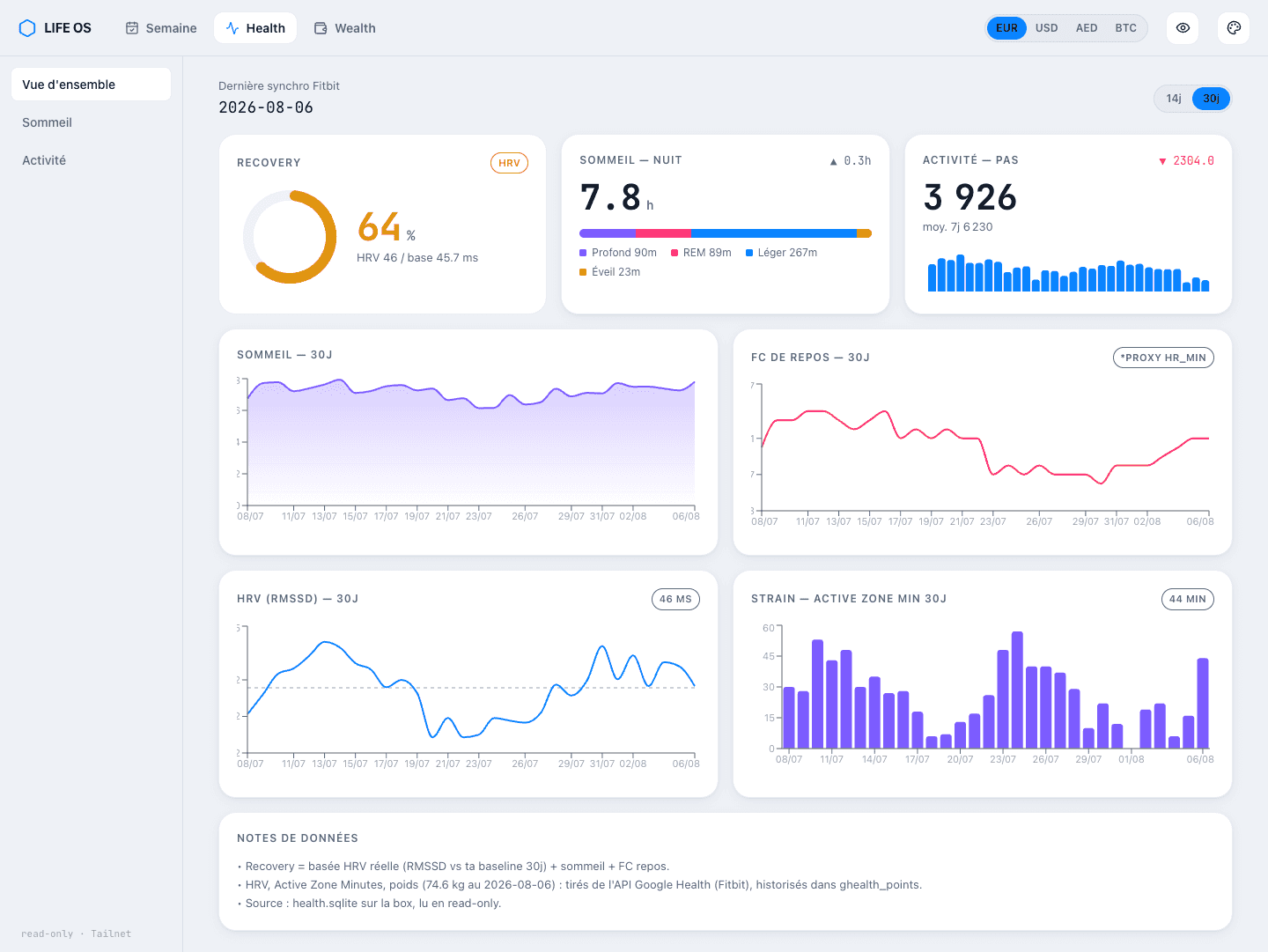
The health view has a Recovery score. Recovery scores are exactly the kind of number that becomes a black box you half trust and can’t argue with. So the formula lives in about eight readable lines, and the ratio is clamped so one freak night can’t swing the score:
def _recovery(hrv_today, baseline, sleep_h, resting):
    """Recovery HRV-based (0-100) : 60% HRV vs baseline + 25% sommeil + 15% FC repos."""
    if not hrv_today or not baseline:
        return None
    ratio = max(0.6, min(1.4, hrv_today / baseline))
    hrv_norm = (ratio - 0.6) / 0.8 * 100
    sleep_norm = min(100, (sleep_h or 0) / 8 * 100)
    hr_norm = max(0, min(100, (70 - (resting or 60)) / 30 * 100))
    return round(0.6 * hrv_norm + 0.25 * sleep_norm + 0.15 * hr_norm)
Note the early return None. When there’s no HRV data, the server returns nothing rather than guessing. The front end then falls back to a cruder sleep-plus-resting-heart-rate estimate and labels the tile “proxy” instead of “HRV”. The same panel is honest about the resting heart rate too: the device doesn’t expose a true resting value, so the card carries a small *proxy hr_min chip.
Labelling a proxy costs one chip in the UI and saves you from trusting a number you invented.
The API is 350 lines of stdlib, the dependencies live in the front end
The API is about 350 lines of python standard library. http.server, sqlite3, json, re. No framework and no ORM, nothing extra to patch on a machine I’d rather not babysit. The same handler serves the JSON endpoints and the compiled front end out of web/dist, with an index fallback for client-side routing.
The front end is where I spent the dependencies: React with Vite, Tailwind, Recharts for the charts, Framer Motion for the transitions, Lucide for icons. Four endpoints feed all of it: /api/health, /api/wealth, /api/agenda, /api/rates, plus /api/ping for the smoke test.
Aggregation that depends on a toggle happens in the browser rather than the API. The personal versus consolidated switch, the currency switch and the anonymous mode all recompute client side from one payload:
export function aggregate(accounts: WealthAccount[], includePro: boolean): Agg {
  const inScope = (a: WealthAccount) => a.scope === "perso" || (includePro && a.scope === "pro");
  const assets = accounts.filter((a) => inScope(a) && a.kind !== "debt" && a.amount_eur != null);
  const debts = accounts.filter((a) => inScope(a) && a.kind === "debt" && a.amount_eur != null);
  const brut = assets.reduce((s, a) => s + (a.amount_eur || 0), 0);
  const debt = debts.reduce((s, a) => s + (a.amount_eur || 0), 0);
  ...
}
One request, instant toggles, and an API that stays a dumb pipe. The opinion: push view-level aggregation to the client when the whole dataset is a few kilobytes. Every filter you move into the API becomes a query parameter you have to version.
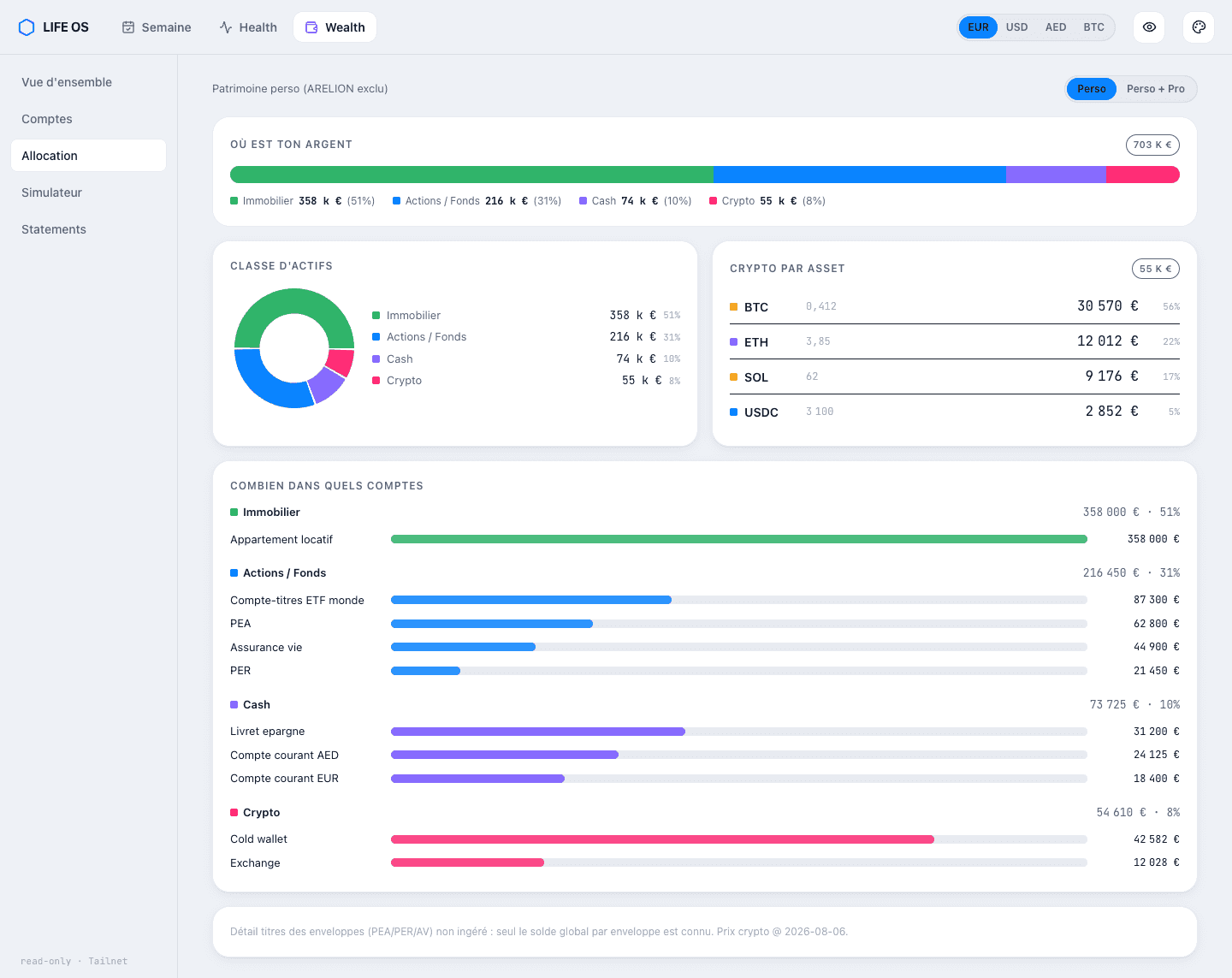
The simulator reuses that aggregate as its starting point, so it holds no hardcoded figure. It won’t render until the real wealth payload has loaded, which is why the projection always starts from the actual net worth rather than a placeholder.
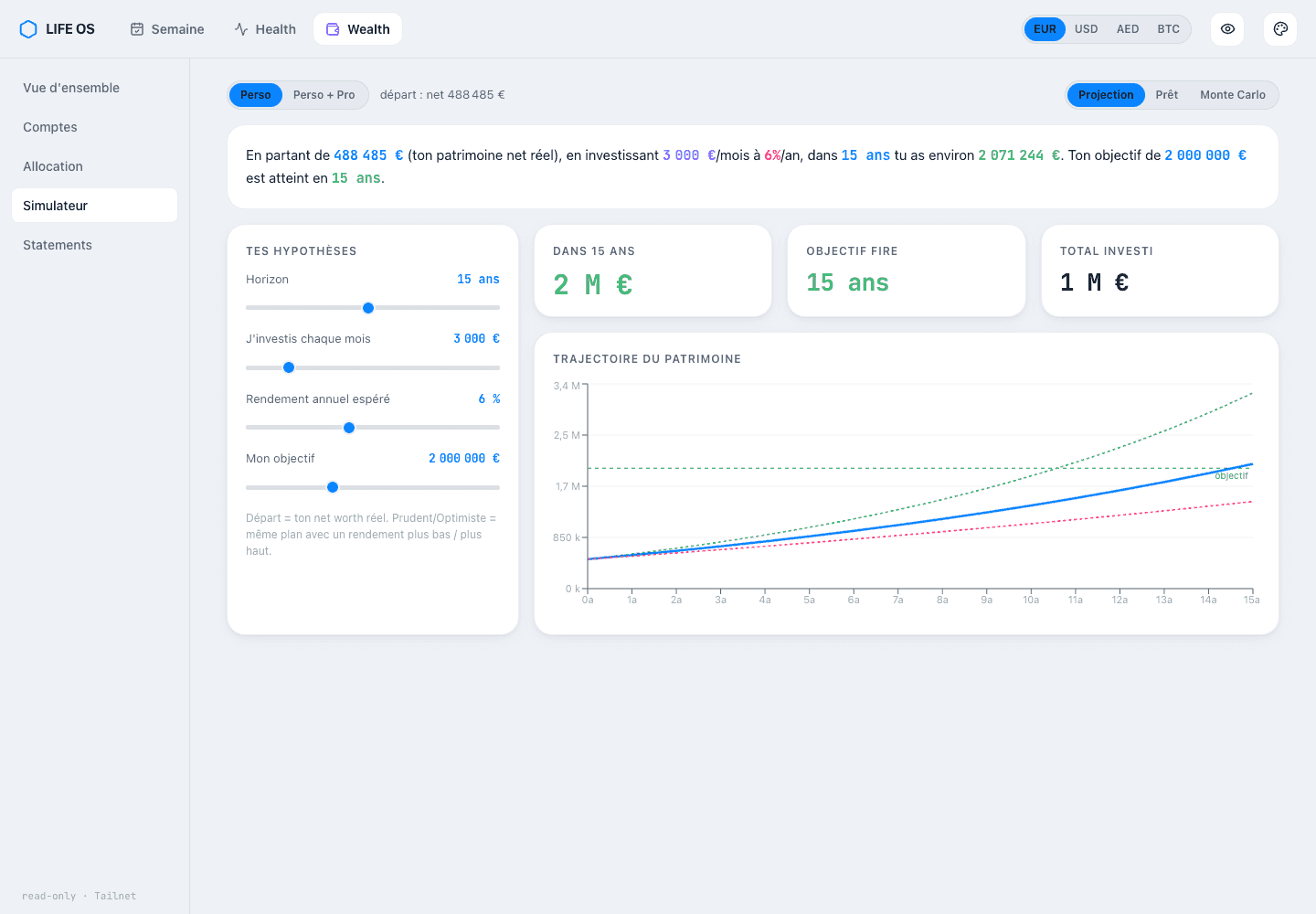
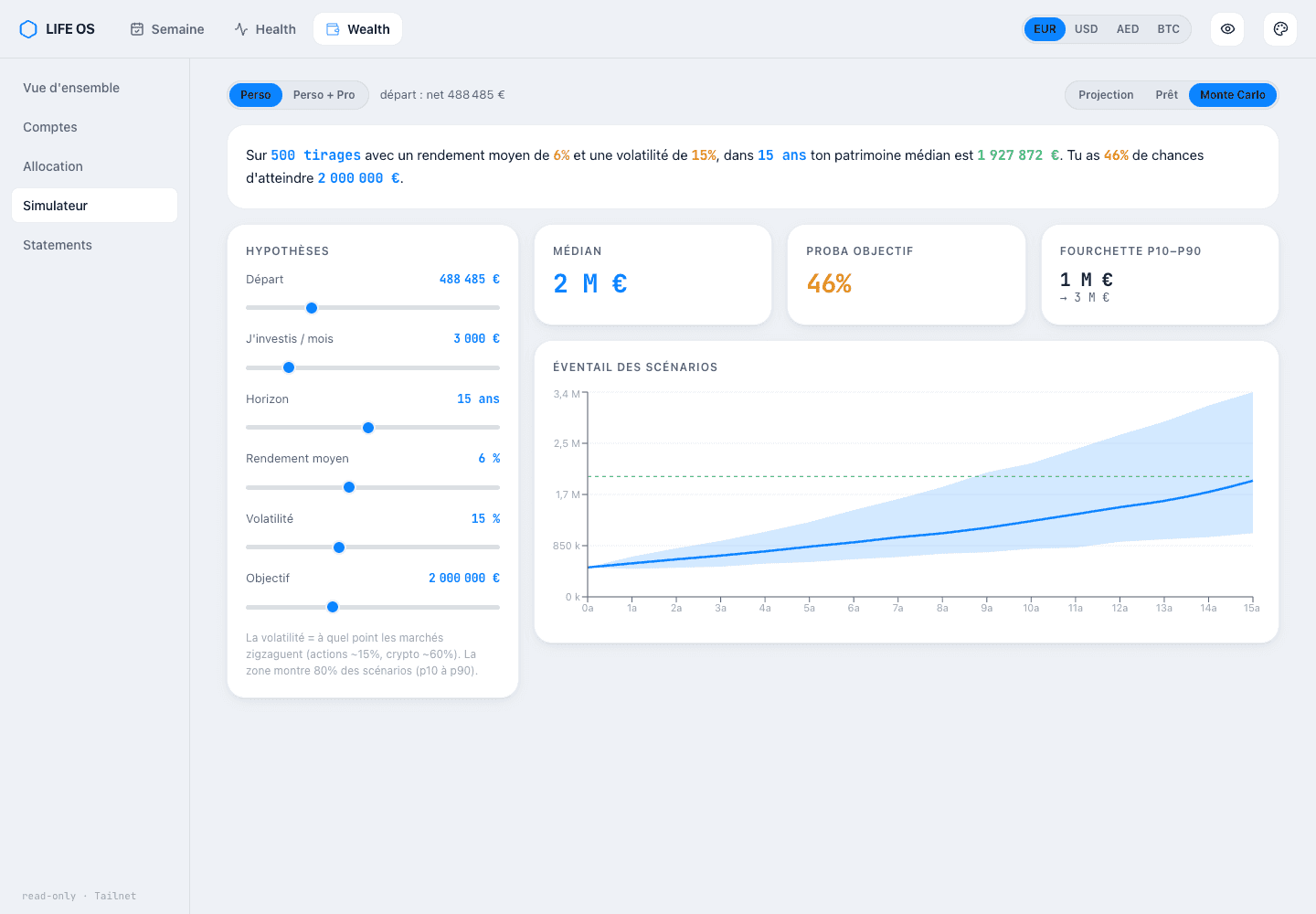
The Monte Carlo mode runs 500 paths in the browser with a deterministic engine: I supply mean return and volatility, it composes and reports percentiles. It predicts nothing. It only says what my own assumptions imply, which is the only honest thing a projection can do.
The week view is a text parser, and that is fine
The agenda panel has the least impressive architecture and the highest daily value. A script on my laptop parses my notes vault with regular expressions, pulls focus items, open checkboxes and pending follow-ups, and pushes a JSON file to the box. The box parses a calendar ICS file for the next seven days and merges the two.
Recurring events are dropped on purpose. Standups and weekly syncs are noise on a “what is different this week” screen:
for block in raw.split("BEGIN:VEVENT")[1:]:
    block = block.split("END:VEVENT")[0]
    if "RRULE" in block:  # recurrents = bruit (standups...), on saute
        continue
Regex over ICS is wrong in general. It works because I control the one calendar exporter, and the worst failure mode is a missing line on a page I look at daily. I wouldn’t ship this for anyone else. For me it replaced a real product.
Three limits I know about and have not fixed
The tailnet is the whole perimeter. Any device on my private network can read everything with no second factor. That is an accepted tradeoff for a single-user tool rather than a design I would hand to a family or a team. Adding real per-user auth means adding an identity store, which means adding a write path, which is the thing I removed on purpose.
The static file guard uses a prefix check, which is the wrong comparison. The handler resolves the requested path and compares it with str(target).startswith(str(WEB_DIR)). A sibling directory whose name starts with the same string would pass. It can’t happen with my current layout, and it’s still the wrong comparison. Path.is_relative_to is the correct one and it’s on my list.
The dashboard is coupled to schemas it does not own. The queries are raw SQL strings against tables another service writes. If a column gets renamed, a chart goes blank at runtime with nothing failing at build time. The smoke test catches a totally broken payload but misses a quietly missing column.
Who has this problem
Anyone whose truth is spread across systems that each hold a correct fragment and no view of the whole: an operator reading three SaaS dashboards to answer one question, a finance team reconciling a bank export against an internal ledger, an ops team where the answer exists in four tools and lives in nobody’s head. The pattern transfers directly. Leave every system owning its own data, add a read-only reader over the top, compute the decaying numbers at read time, and make every panel say out loud when it doesn’t know.
Questions I get about this
What is a personal life OS dashboard?
One private place that pulls health, money and calendar into a single view, so you see your real state today instead of opening four apps. It is read-only over your own data.
How do you keep a self-hosted dashboard's numbers correct?
The store is the source of truth, values are recomputed on every view rather than frozen, and the serving layer is read-only at the driver level, so a bug in the app cannot mutate the data.
Is a self-hosted life dashboard worth building over off-the-shelf apps?
If your data lives across many apps and none can answer "what is it today", a thin read layer over your own store gives one honest view without handing your finances and health to a third party.
Got this problem? I'll look at yours, in writing.
Book a call