
An autonomous research agent over a private corpus (RAG, Google ADK)
August 5, 2026
An autonomous research agent over a global enterprise's private corpus of R&D reports, patents and contracts, which I designed and built. The interesting part is not the retrieval, it is the code that stops the agent from shipping a confident half-answer: on a multi-part question, a hard barrier in the loop refuses to let it finalize until every part is covered or honestly marked 'no data found'.
You are reading the plain-language version. Switch to Tech for the code and the architecture.
Question
Document the performance of these four product lines: A, B, C, D. Cite a source for each, or say no data found.
Answer
One line per base, each with a citation to the exact page, and an explicit 'no data found' where the corpus is silent, after the agent searched every base separately.
Sources
lab_report_A.pdf · p.4stability_study_B.pdf · p.2Ask a chatbot to compare four product lines and it describes two, fluently, then stops. Someone then digs out the other two by hand, or nobody notices and a decision rides on half the data. I build research agents that answer every part of the question from your own documents, with each claim cited to the exact page. I shipped one for a global enterprise, over decades of its reports, patents and contracts, most of them scans nobody could search.
Multi-part answers went from roughly 40% to 98% complete, with 0 silent half-answers in production (illustrative figures). Now used across 4 teams.
Where the time goes today
Hunting through documents takes hours, and a fluent half-answer makes it worse. A blank answer gets double-checked; a confident partial one gets trusted. The missing part surfaces weeks later, when someone reopens the file and redoes the work.
What changes
- The whole question, answered. Ask about four things and get four sourced answers, including the ones it had to dig for.
- A source on every line. Every claim points to its page, or the agent says it found nothing. It never answers from memory.
- Old scans made searchable. Scans, born-digital files and a dozen languages become one corpus you can query.
- Each person sees only what they are cleared for. Access is enforced on the data itself.
The gain is measured: I can switch the diligence off, run the same graded questions both ways and compare. One limit: it is built for questions your documents can answer, and it tells you when they cannot.
What I can do
I build the reading pipeline, the search and the rule that forces a complete, sourced answer. I can also start smaller, with an assessment of where your current AI stops early on multi-part questions.
Want me to look at yours, in writing?
A tool-using LLM asked to compare eight things will answer about two, fluently, and stop. The half-answer reads as finished, so the reader trusts it and moves on. I built a research agent that won’t do that: it answers every part of a multi-part question over a private corpus, or says “no data found” for the parts the documents can’t answer.
I built it for a global enterprise, over decades of R&D lab reports, patents and signed contracts, in a dozen languages, most of it trapped inside scanned PDFs that nobody could search.
Multi-part answers went from roughly 40% to 98% complete, and 0 silent half-answers have shipped since.
The RAG itself is standard. What follows is one specific failure, and the code that fixes it.
The failure everyone ships
Ask a tool-using LLM to compare eight things and it does this:
user: document the performance of bases A, B, C, D. cite a source for each.
agent: [semantic_search "performance A B C D"]   ← one blended search
agent: "Here is the performance of A and B: ..."  ← ships with 2 of 4
One search, the first two hits, and a fluent answer that reads as finished while it’s missing half the question. A half-empty answer that looks complete is worse than no answer, because the reader trusts it and moves on.
Prompting doesn’t fix this. “Be exhaustive, don’t leave gaps” is a suggestion the model drops the second it can produce fluent text. So I stopped asking, and made it structural instead.
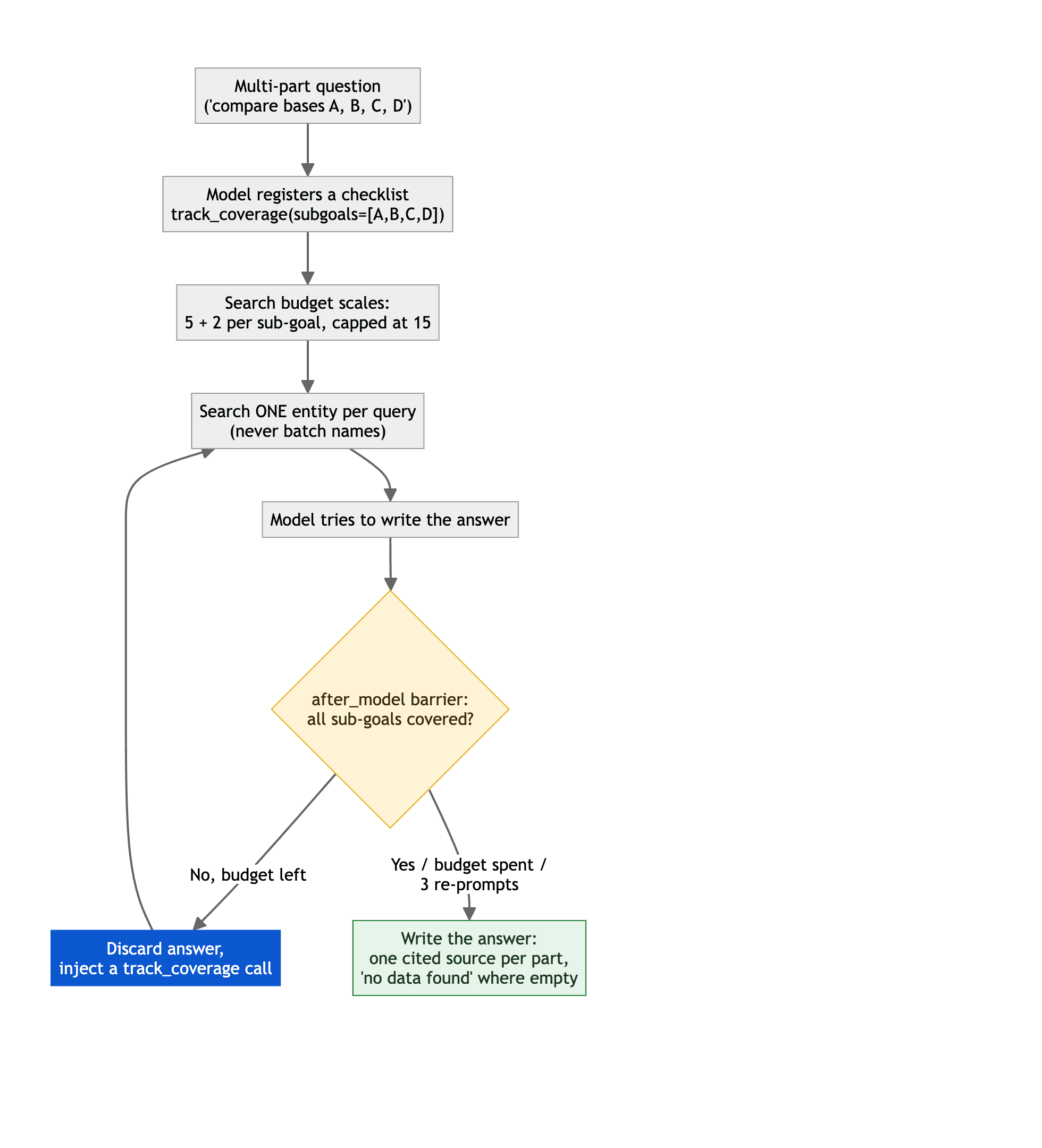
Fix 1: make the agent declare a checklist
A new tool, track_coverage, forces the model to write down the parts before it searches, and returns a directive instead of a polite nudge:
def track_coverage(subgoals=None, covered=None):
    """Register sub-goals for a multi-part request, then tick them off.
    Only for genuinely multi-part work, never a single question."""
    state.setdefault("_coverage", {"subgoals": [], "covered": []})
    if subgoals:
        state["_coverage"]["subgoals"] = dedup(subgoals)   # PLAN
    if covered:
        state["_coverage"]["covered"] = dedup(state["_coverage"]["covered"] + covered)  # UPDATE

    open_ = [s for s in state["_coverage"]["subgoals"]
             if s not in state["_coverage"]["covered"]]
    if open_:
        return (f"{len(open_)} of {len(subgoals or [])} sub-goals are still OPEN. "
                "Do NOT answer yet. Search the open ones now, "
                "ONE entity per query (never batch names).")
    return "All sub-goals are covered. Write the final answer, citing a source for each part."
“One entity per query” matters for a concrete reason: eight names in a single embedding query dilute the ranking, and most of them never surface. So I designed the prompt and the budget together, to push the agent toward eight separate searches instead of one blended query.
Fix 2: scale the budget to the declared plan
Left uncapped, an agent burns tokens forever. Capped flat at 5 searches, it literally can’t cover 8 bases. So the ceiling grows with the checklist the model registered for itself:
_BASE, _PER_SUBGOAL, _CEILING = 5, 2, 15

def expensive_budget(state):
    if PERSEVERANCE_OFF:
        return _BASE
    n = len(state.get("_coverage", {}).get("subgoals", []))
    return min(_BASE + _PER_SUBGOAL * n, _CEILING)   # 4 bases -> 13 searches
The agent earns more search budget by committing to a plan, and the hard ceiling of 15 keeps latency bounded.
An eight-part question now fires eight separate searches, up from the one blended search that used to return two answers.
Fix 3: a barrier it can’t talk past
This is the trick that carries the whole thing. Google ADK lets you run a callback after every model turn. When the model tries to finalize while sub-goals are still open and budget remains, I throw its answer away and hand it a forced tool call, which shoves the loop back into searching:
def enforce_coverage(callback_ctx, llm_response):
    cov = state.get("_coverage")
    open_ = has_open_subgoals(cov)
    is_answer = llm_response.text and not llm_response.function_calls

    if (PERSEVERANCE_OFF or not open_ or not is_answer
            or budget_spent(state) or reprompts(state) >= 3):
        return None                       # let the answer through

    state["_coverage_reprompts"] += 1
    return LlmResponse(content=Content(role="model", parts=[Part(
        function_call=FunctionCall(
            id=f"coverage-gate-{uuid4().hex[:12]}",   # MUST be non-empty (see below)
            name="track_coverage", args={}))]))
It turns a prompt suggestion into control flow the model can’t argue with. I bound it to 3 re-prompts so it can never deadlock, and it passes through untouched when perseverance is off, nothing is open, or the budget’s gone.
War story. The first version left that
idempty. Gemini on Vertex 500s with “Missing corresponding tool call for tool response”, because it pairs a call to its result by id. Empty id, no pair, hard crash. It is now an assertion in a regression test.
Framing the run: a goal, a scope, and a turn that stops searching
The checklist, the budget and the barrier only pay off if the run itself is framed right. Two decisions do most of that work.
First, the agent takes a goal rather than a raw query. A user states what they want to know, and a short scoping step captures the constraints before anything runs: which sources count, the time window, the shape of the answer they expect. The agent commits to the goal and the scope, instead of guessing at both from one sentence.
Second, the search budget is phased across the run. Research turns get a high ceiling so the agent can actually cover an eight-part question. The final synthesis turn gets a deliberately low one, so the model has to stop searching and write:
def turn_budget(state, *, phase):
    if phase == "research":
        return expensive_budget(state)   # scales with the checklist, up to the ceiling
    return _BASE                          # synthesis turn: low on purpose, so it commits
Without that low synthesis ceiling, a capable agent keeps finding one more thing to check and never delivers the dossier. The output follows a contract of its own: every claim carries a source, and the run ends on a synthesis with headings rather than a loose chat reply. And a strong model is pinned for the whole run, independent of whatever model the interactive chat happens to be on, so a long investigation never quietly downgrades halfway through.
Prove it, don’t believe it
Every knob has an off switch, PERSEVERANCE_OFF=1, which disables budget scaling and the barrier at once. It doubles as the A/B lever: run the same graded set with it on and off and read the delta.
The eval cases are grounded. I mined them from real production conversations, confirmed each ground truth against the source document, then pinned them as regression cases. The canonical one encodes the exact behavior as a reference trajectory:
{
  "eval_id": "four_bases_perf",
  "prompt": "Performance of bases A, B, C, D. Cite a source each, or 'no data found'.",
  "reference_trajectory": [
    {"name": "track_coverage", "args": {"subgoals": ["A", "B", "C", "D"]}},
    {"name": "semantic_search", "args": {"query": "performance base A"}},
    {"name": "semantic_search", "args": {"query": "performance base B"}},
    {"name": "semantic_search", "args": {"query": "performance base C"}},
    {"name": "semantic_search", "args": {"query": "performance base D"}},
    {"name": "track_coverage", "args": {"covered": ["A", "B", "C", "D"]}}
  ],
  "reference_answer": "A: ... [src p.4]  B: ... [src p.2]  C: ... [src p.7]  D: no data found."
}
Two scores. A trajectory metric checks that the agent decomposed the request and searched each entity on its own. An LLM judge, run through the same private gateway with a strict 0-to-1 rubric, scores the answer against that reference. A single bad row fails on its own (scored NaN) and never aborts the run.
With perseverance off, the graded set scored 0.41 on completeness. On, 0.98. Same questions, same corpus, one flag.
The plumbing under it is deliberately boring
The perseverance layer only earns its keep because everything beneath it is dull and correct.
Reading is native-first. A scanned PDF is a picture of text; a born-digital one already has the text. So the pipeline lifts the embedded layer for free when it exists and only pays for OCR on real scans, at higher DPI, where it is actually needed:
words = page.get_text("words")
if page.rotation in (0, None) and len("".join(w.text for w in words)) >= 40:
    text, dpi = lift_text_layer(words), 200   # free, zero OCR error
else:
    text, dpi = ocr(render(page, dpi=300)), 300   # scans only, more pixels
Native-first reading skips OCR on about 70% of pages, at zero OCR error wherever a real text layer exists.
Tables get a real cell grid (a table-structure model matches words to cells by geometry, so the columns survive), and a hallucinated 200-column table gets dropped while the rest of the document stays: empty beats invented. Repeated images like logos and hazard symbols are captioned once by a vision model, then content-hash cached, so nobody pays twice to describe the same picture.
The queue is the database. No Kafka, no Celery, no Pub/Sub. A document is a row with a status, and workers claim work with one Postgres primitive:
SELECT * FROM docs
WHERE status = 'OCR_DONE'
ORDER BY updated_at DESC
FOR UPDATE SKIP LOCKED   -- many workers, one table, never the same doc twice
LIMIT 5;
Fewer moving parts, and one place to look when something runs late. A weighted fair queue picks which use case to serve next, so a one-time bulk load of 80k certificates can’t starve the scientist waiting on a single new report.
Retrieval runs three searches, then a small-to-big ladder. Semantic (multilingual vectors, so a French query finds an English doc), full-text (for the patent number a vector blurs), and title. A hit surfaces the exact page; from there the agent greps inside a known doc, fetches specific pages, and pulls a whole document only when it’s short. A shared character budget caps the lot, so nothing overflows the model.
Access is enforced inside the query itself. Two people from two teams ask the same question and get answers from two different slices of the corpus, and neither one can tell the other slice exists.
Who has this problem
Wiring an AI to a folder of documents is an afternoon demo. Making it faithful to tables, sourced on every sentence, airtight on access, and exhaustive on multi-part questions is a different job.
The architecture transfers as-is. Anyone with a decade of documents nobody can search has the reading and retrieval problem: pharma dossiers, contract and KYC files, legal clauses, insurance claims in five layouts. And anyone whose AI answers look complete while they fall short has the perseverance problem. That’s the part almost nobody builds, because it lives in the agent loop, where prompting can’t reach.
Questions I get about this
How do you stop a RAG agent from answering only part of a multi-part question?
Make it declare a checklist of sub-goals before it searches, scale its search budget to that checklist, and add a callback that blocks a final answer while any sub-goal is still open. Prompting alone does not hold.
How do you measure whether an AI agent actually improved?
Keep a graded set mined from real production queries, with a hard off switch for the behavior under test, and run the same set on and off to read the delta. Score both the search trajectory and the final answer.
Can it run on a private corpus with per-team access control?
Yes. Access is enforced inside the retrieval query, so two people on different teams get answers from different slices of the corpus and neither can tell the other slice exists.
Got this problem? I'll look at yours, in writing.
Book a call